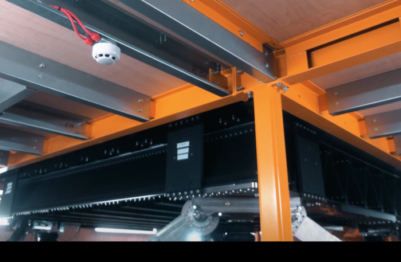
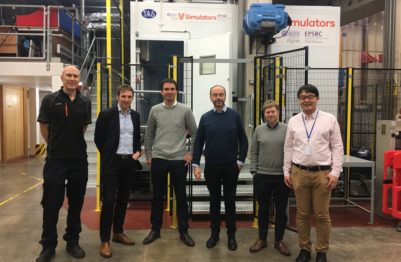
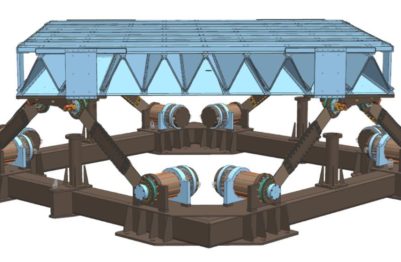
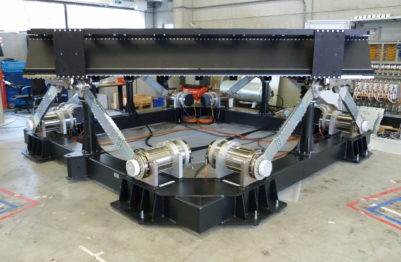
PhD student Naser Taleshi is using the Exeter VSimulator to explore the balance and control methods used by people standing or walking on moving surfaces.
Naser’s PhD project is investigating the mechanisms of balance and stability for different types of floor motion (roll, pitch, heave, and sway) at different levels and frequencies, representing real situations in transport and on structures. His aim is to identify challenging environments and enable them to be better designed for people with balance problems.
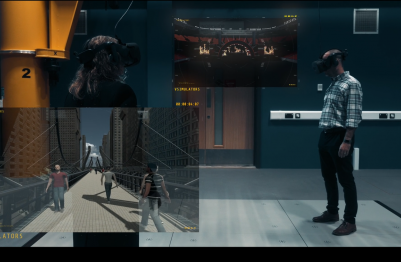
Naser is making full use of the facility’s AMTI multi-access force plates supplied by Summit Medical & Scientific, the automated motion capture systems and the virtual reality supplied by experience designers Holovis.
Human and structure movement and force data will be collected using the force plates and motion capture to enable further understanding of the potential mechanisms responsible for human response to vibration and underlying motor control process.
Naser said: “It is excellent to be able to make use of this state-of-the-art VSimulator’s facility’s full capabilities for this research, and we have already carried out a pilot balance control test there.
“As well as the human motor output, the virtual reality will be used to help us better understand the neural systems and processes that underlie the human sensory system.
“This will ultimately provide a more comprehensive view of the dynamics of human structure interaction.”
Naser is conducting the EPSRC-funded PhD study Dynamics of human-structure interaction under the supervision of Prof James Brownjohn in the Vibration Engineering Section and Dr Genevieve Williams in Sport & Health Sciences.